



Teaching Data Formats in Design and Manufacturing
 With approximately 2,150 students and 120 teachers, Gottlieb-Daimler-Schule 2 (GDS2) is one of the largest educational institutions in Baden-Württemberg, Germany. The College of Computer Science (ADV – Academy for Data Processing), which forms part of GDS2, offers a three-year programme for students who have completed their Abitur (German university entrance qualification) or hold a good advanced technical college entrance qualification.
The programme leads to the professional qualification of State-Certified IT Specialist (Staatlich geprüfte Informatikerin / Staatlich geprüfter Informatiker). It provides a practical alternative to a university degree and specifically prepares graduates for careers in the media, business and technology sectors.
An important part of the curriculum is the teaching of various data formats used across numerous areas of industry and the media. Computer Aided Design (CAD) is an important aspect of computer-aided manufacturing. However, the primary focus is not on the actual design process, but rather on understanding the underlying data structures of CAD/CAM systems. Since most commercial CAD applications use proprietary file formats that are not openly documented, ADV decided back in 2003 to adopt Pictures by PC, the CAD/CAM software developed by the German company SCHOTT SYSTEME GmbH.
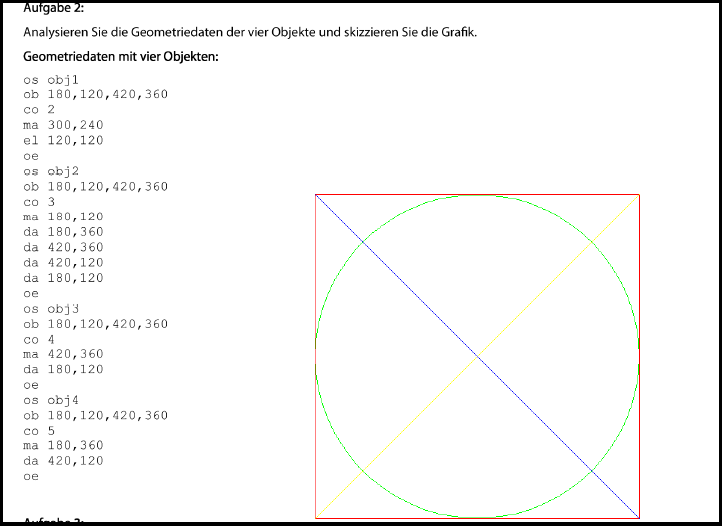
Since its introduction in 1984, Pictures by PC has consistently used the same open data format, offering exceptional continuity for more than 40 years. Its 2D CAD syntax is based on four fundamental geometric elements: polygons, circular arcs, Bézier curves and text. Using an internal command syntax modelled on a plotter language, with instructions such as MA (Move Absolute) and DA (Draw Absolute), students gain an in-depth understanding of the structure of CAD data. They also create technical drawings directly at this syntax level.
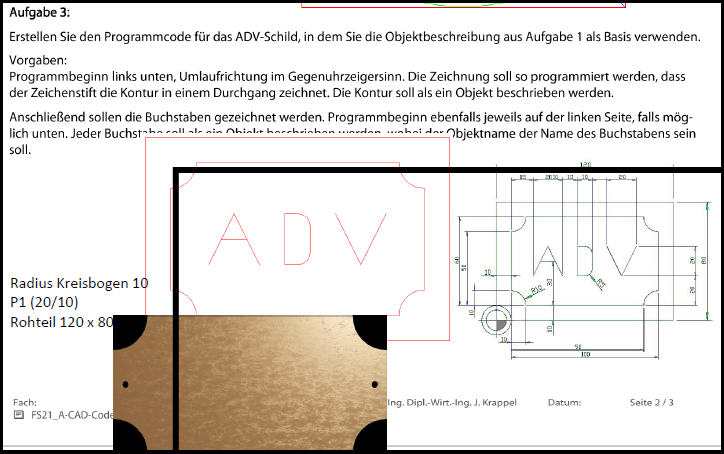 Students also make use of the integrated CAM functions in Pictures by PC to learn the fundamentals of computer-aided CNC programming. The input data may, for example, be provided as a bitmap image, which the software converts into 2D CAD contours through vectorisation. Alternatively, geometries created directly using the 2D CAD syntax described above can be used for manufacturing without any additional intermediate steps.
The students then explore the fundamental processes of Computer Aided Manufacturing (CAM), including contour milling, pocket milling and engraving. By generating and analysing NC programmes, they gain practical insight into how CAD geometries are translated into machine instructions for CNC manufacturing.

